
News
/
December 2025
A Letter from the Founders of Fortell

Anyone who has tried to hold a conversation in a noisy restaurant knows the frustration of straining to hear over the voices around you. For people with hearing loss, this challenge is magnified: conventional hearing aids amplify everything, making crowded environments almost unbearable. At Fortell, our focus from day one has been to build a hearing aid that helps people hear better in background noise.
From our earliest prototypes, we could tell that our hearing aids sounded better than conventional hearing aids available today, but we were obsessed with the question of whether the AI was delivering measurable, objective improvements to intelligibility. In other words, would our hearing aids help people understand more words correctly in the most challenging environments?
To answer this question, we partnered with a team of academic researchers1 and conducted a double-blind randomized controlled trial comparing Fortell hearing aids to the leading premium AI hearing aid. We designed the study as follows:
30 experienced hearing aid wearers
1) Fortell Hearing Aids and 2) control AI hearing aids from the top hearing aid manufacturer. Both pairs were tuned to each participant's hearing loss and set to their maximum available settings for directionality and noise reduction.
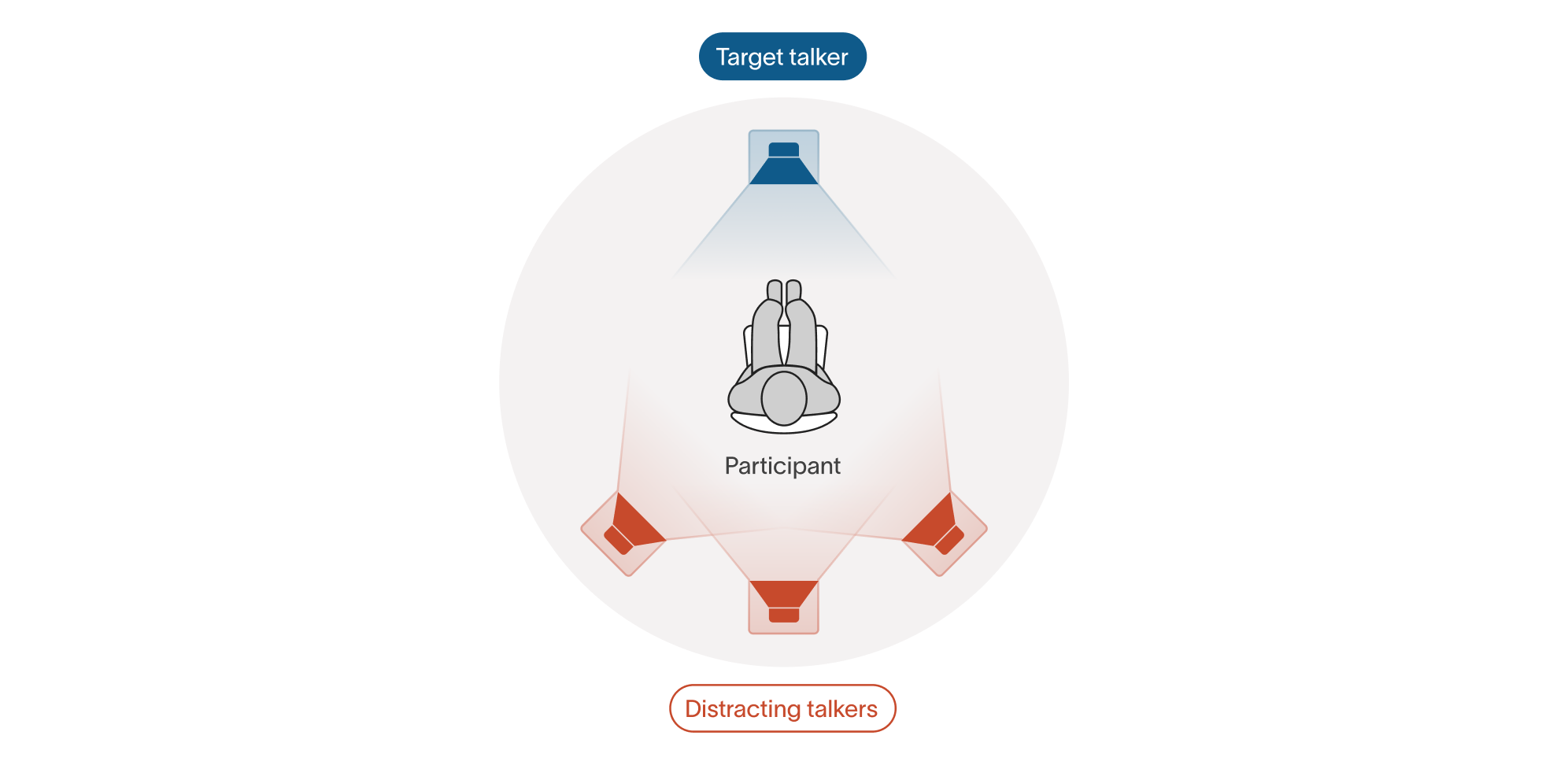
Participants completed a speech-in-noise test in a sound-controlled environment. Participants faced a front speaker playing target sentences while three speakers to the back played loud competing conversation as background noise. Figure 1 below shows the positioning of the speakers relative to the study participant during testing.
Each participant listened to 60 sentences across three difficulty levels (medium, hard, very hard). They wore Fortell AI Hearing Aids for half of the test and the control hearing aids for the other half.
Neither participants nor the researchers scoring the test knew which device the participant was wearing at any moment. Furthermore, the order of conditions was randomized across participants.
Performance was scored by calculating the percentage of target words correctly identified (5 per sentence) at each signal-to-noise ratio.
Every single participant performed better with Fortell than with the control device.
Moderate noise →Understanding improved from 69% to 90%
Difficult noise →From 31% to 80%
Most challenging noise →From 7% to 50%
In the hardest condition, participants went from catching only one word in twenty to following more than half of the conversation — a nearly ten-fold improvement. These results were statistically significant across all test conditions.
.png)
These results confirm that the AI in Fortell hearing aids has the potential to significantly improve speech understanding in noisy situations. The improvement is not only statistically significant but functionally meaningful–a shift from hearing bits and pieces to following complete conversations, even in the most difficult conditions. It gives people with hearing loss a tool to thrive in places where traditional hearing aids fall short.