
News
/
December 2025
A Letter from the Founders of Fortell

Every new hearing aid promises the same thing: hear clearly, even in background noise. The marketing buzzwords change—AI, smart processing, adaptive filters—but the promise remains unfulfilled: voices blur together, and background noise gets louder right along with the conversation. Frankly, most hearing aids, even the premium ones, sound very similar to one another, because the technologies they are using are very similar.
From the start, our mission at Fortell has been to build a hearing aid worth building: one that would sound meaningfully better in noise. Incremental progress was never the goal, so instead of improving on existing technology, we developed a custom AI processor that could separate speech and noise and then rebuilt the hearing aid around that core invention.
To cut through all the marketing noise, we posed a simple question: Do people think it sounds better? To answer it, we designed a “Pepsi Challenge” experiment to compare Fortell head-to-head with today’s high-end technology.
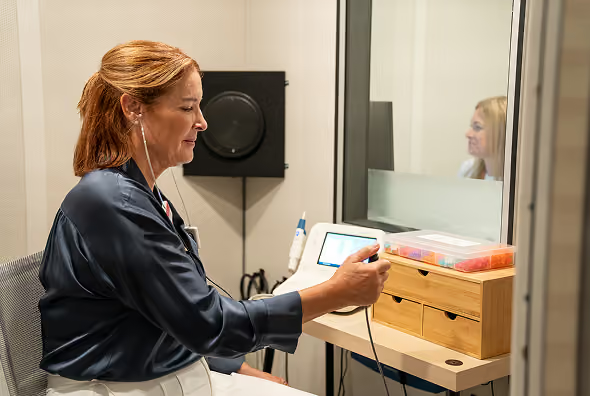
Twenty experienced hearing aid wearers compared Fortell to the latest premium devices from five leading manufacturers.
Each pair of hearing aids was tuned using manufacturer-recommended settings for noisy environments.
Participants listened to realistic recordings of busy streets, restaurants, a train station, and other noisy places, each with a target talker and challenging background conversation.
For every comparison, they heard two recordings of the same scene: one with Fortell and one with a competitor. Without knowing which was which, they rated which made speech easier to understand on a 5-point scale.
Each participant completed 100 comparisons, producing a robust dataset across all five competitors.
The outcome was decisive: 95% of participants preferred Fortell
In other words, when faced with the exact situations where hearing aids are most likely to be tested—noise, chaos, overlapping voices—nearly everyone heard the difference immediately.
Ultimately it’s not about AI. It’s about what the AI does. If you can’t hear the difference, it’s probably not helping very much.
The results from our study make clear that the Fortell advantage is not only audible, but significant. Listeners didn’t just prefer Fortell—they chose it by a margin wider than the gaps separating any of the competitors.
If you’re considering hearing aids, don’t rely only on written claims or marketing language. Every company promises better performance in noise—but the real test is whether you can actually hear the difference. We invite you to visit the Fortell Audiology Clinic in New York, bring your current pair of hearing aids, and do a side-by-side comparison.