Product
/
September 2026
How Do Hearing Aids Work?

Connection is fundamental to Eugene’s personal identity. While he’s more reserved by nature, he often shows care and presence not by dominating a room, but by being intentional and a deeply attentive listener.
This ability to connect was slowly eroding alongside his progressive hearing loss. "I was consciously withdrawing from conversations because I couldn't hear and keep up,” he said. As a result, Eugene found himself feeling more isolated and even disconnected from himself.
He had done what he thought was the right thing: he invested in "top-of-the-line" premium hearing aids. Yet nothing seemed to help with his core challenge of understanding his family and friends in social spaces. He assumed that things were as good as they could get.
It wasn't until his wife discovered Fortell and booked him an appointment that Eugene finally found the key to stepping back into the conversations and the relationships he valued most.
After years of relying on conventional hearing aids, Eugene was exhausted. In loud environments or crowded rooms, his hearing aids were more irritating than helpful, failing to deliver the clarity he needed to actually understand the people right in front of him.
He estimated he was only picking up on 30% to 50% of conversations. For someone who identifies and connects by actively listening, trying to bridge that gap requires an exhausting amount of mental effort. "I felt like I had to raise my game just to listen… it was tiresome," Eugene said.
"I felt like I had to raise my game just to listen… It was tiresome. I was actively avoiding and withdrawing from conversations."
Eventually, the strain became too much. To protect his energy, he found himself making a choice that went entirely against his nature: "I was actively avoiding and withdrawing from conversations,” he said.
His hearing limitations didn't just affect his social life; they warped his sense of security. He began losing the ability to pinpoint where sounds were coming from, leading to a constant feeling of disorientation in crowded, busy spaces.
Beneath the exhaustion was a profound sense of grief. "Hearing is a fundamental piece to feeling confident. People take it for granted," Eugene said. Watching his world shrink—and feeling unable to connect with the people he loved—felt deeply sad. And because the best technology on the market couldn't improve it, he felt entirely hopeless.
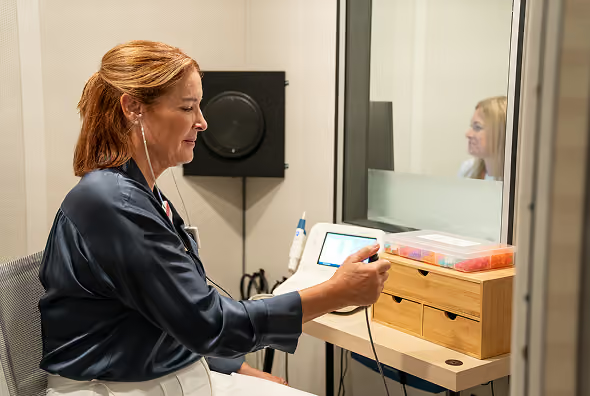
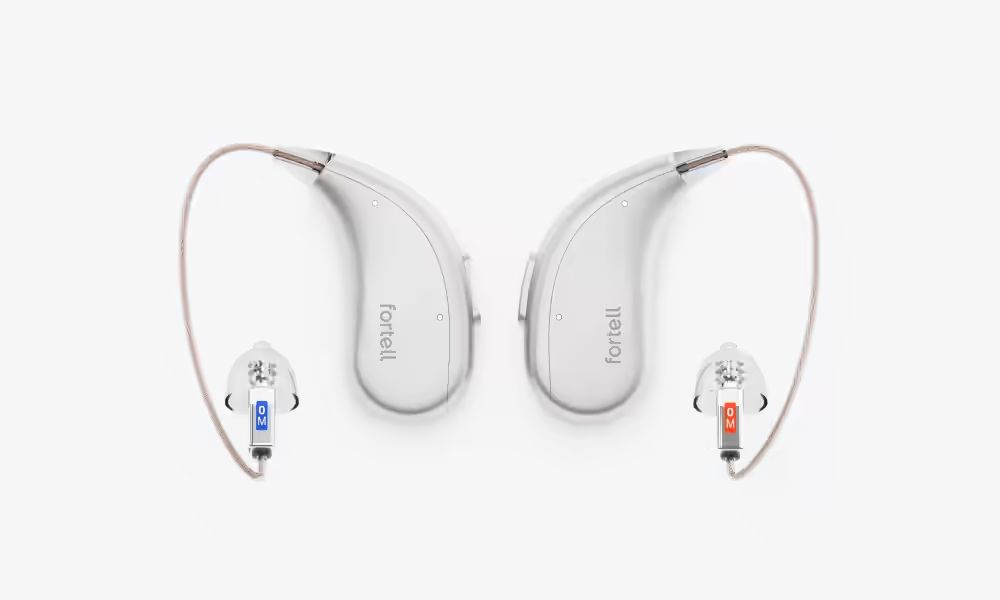
The turning point came from a completely unexpected source. Eugene's wife happened to read an article in Wired magazine highlighting a new kind of hearing aid called Fortell. Intrigued by the endorsement that Fortell was materially and structurally different from traditional tech, she surprised Eugene by booking him an appointment.
"For the first time in a long time, I know my future will be better than my past. I have a renewed sense of confidence."
Because of the Wired endorsement, Eugene expected Fortell to be better than his existing hearing aids, but nothing prepared him for the moment he actually tried them.
"It was a night and day difference… I was floored," he says. Rather than the small adjustments he had come to expect from his hearing aid upgrades, this felt like an entirely new “breakthrough standard.”

After a few months of wearing his Fortell AI Hearing Aids, Eugene described the transformation as nothing short of a sensory awakening. "My world has color again," he said.
The rich, subtle baseline of daily life has returned. He can hear the natural, high-fidelity sounds he hadn't realized he was missing, from the cat meowing to the distinct sound of a door shutting.
For Eugene, the heavy cloud of hopelessness has entirely lifted, and his ability to be the listener and connector he always was has returned. "For the first time in a long time, I know my future will be better than my past," he says. "I have a renewed sense of confidence."

