

Clinical Research
/
December 2025
About Hearing Loss
Most people don't think about how a hearing aid works until they need one. Then the questions come fast: what's actually happening inside this thing, and why do some models handle a noisy restaurant so much better than others?
The answer starts with the fact that every hearing aid, regardless of brand or price, is built from the same three parts: a microphone, a processor, and a speaker. What's changed in the last few years is what the processor is capable of doing with the signal before it reaches your ear.
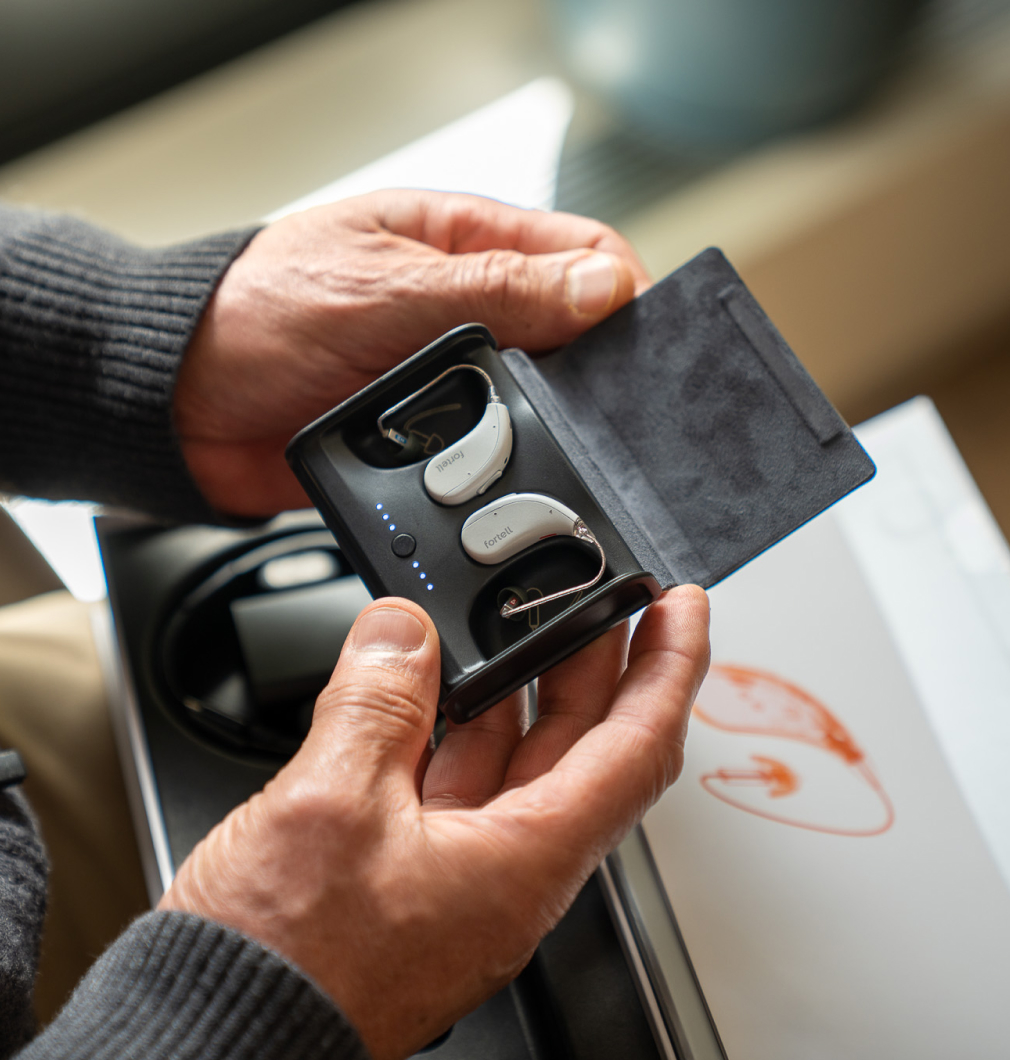
Hearing aids are older than most people assume. Nearly every style on the market today exists because engineers had to solve one specific limitation in the version before it.
For three hundred years, the only real hearing aid was a funnel-shaped ear trumpet — even Beethoven used one. Electric hearing aids arrived in 1898, vacuum tubes in the 1920s, but both were bulky and crude. The real turning point came in 1948, when Bell Labs invented the transistor and let manufacturers shrink the whole circuit small enough to wear behind the ear, the ancestor of the Behind-the-Ear (BTE) style still in use today.
Hearing aids stayed analog for another four decades, with limited ability to treat different sounds differently. That changed in the mid-1990s, when digital processing arrived and let chips shrink small enough to disappear entirely into the ear canal, giving rise to other styles you'll find later in this guide.
More than three decades later, AI is finally providing the next major leap in hearing aids, solving one of hearing science’s toughest challenges: the ability to amplify a single voice clearly above competing background noise. This is the problem Fortell has solved which we’ll explore later.
A hearing aid is a small electronic device you wear in or behind the ear to make sound louder and clearer for people with hearing loss, in both quiet and noisy rooms.
Hearing aids help people whose hearing loss stems from damage to the ear’s sensory hair cells or the auditory nerve pathway. damage that aging, noise exposure, or illness most commonly cause. That range of causes is exactly why such a wide range of people end up wearing one.
Worn consistently, a hearing aid helps you hear speech more clearly, follow conversations with less effort, and stay socially engaged. However, hearing aids do not restore normal hearing and cannot prevent or improve hearing loss caused by natural processes such as aging or illness (full safety and usage information for Fortell devices is available in the instructions for use and FDA disclosure).
A hearing aid works by capturing sound waves, converting them into an electrical signal, and processing that signal (amplifying specific frequencies), before delivering a louder, clearer sound to the ear.
Sound enters the hearing aid through one or more tiny microphones, which convert pressure waves in the air into an electrical signal. Many devices use more than one microphone so they can tell where a sound is coming from, in some hearing aids, that lets the device favor the voice in front of you over the noise behind you.
Once captured, the sound travels to the hearing aid’s processor (also called the amplifier) which decides what happens to that raw signal before it ever reaches your ear. The processor is not just a volume knob, it is the part deciding what is worth hearing at all.
Even the simplest digital hearing aids increase the signal’s strength based on your specific hearing loss, turning up the frequencies you struggle with most. More advanced hearing aids go further: instead of just cranking up the volume, the amplifier analyzes and reshapes the signal, this is the foundation the AI-based technology covers and that will be explained later in this article.
After processing, a tiny speaker inside the hearing aid (also called a receiver), converts that electrical signal back into sound waves and sends them down the ear canal to the eardrum, which vibrates in response. The process sounds simple, but where the receiver sits, and how much room it has, drives both sound quality and comfort. That single design choice is what actually separates one hearing aid style from another, as the next section explains.
People often use “hearing aid” and “hearing device” interchangeably, but they are not the same thing. Hearing devices are the broader category, any product designed to help someone hear better. A hearing aid is one specific type of hearing device: something worn in or behind the ear to amplify sound. Other hearing devices, like cochlear implants or bone-anchored systems, work through entirely different mechanisms, and doctors usually reserve them for hearing loss that amplification alone cannot fix.
Today’s hearing aids do more than amplify sound, the shift from analog to digital processing lets them deliver clearer, more personalized listening. That innovation happens along two tracks: how a hearing aid processes sound (analog vs. digital) and how it delivers that sound to your ear (air conduction vs. bone conduction).
Early hearing aids ran on analog circuitry: they converted sound waves into an electrical signal and amplified it directly, with little ability to treat different sounds differently. Turn one frequency up, and every frequency comes with it. Digital processing changed that by converting sound into a numerical code, which lets the processor adjust pitch, loudness, and other characteristics with far more precision than analog ever could. Since the mid-1990s, digital has been the industry standard, every hearing aid sold today, across every style and price point, runs digital. That precision is also what unlocks more advanced capabilities, including the AI-based technology, although not every digital hearing aid includes it.
Digital hearing aids can also add noise reduction, feedback suppression, Bluetooth streaming, and programmable settings, features that add up to a more personalized experience.
Hearing aids also differ in the way they deliver sound to the inner ear. Most hearing aids work through air conduction, they amplify sound and deliver it through the ear canal to the eardrum. Bone-conduction devices take a different path, sending sound vibrations through the skull directly to the inner ear. Doctors reserve them for specific conditions, like a malformed ear canal or hearing loss limited to one ear, rather than using them as a general alternative to standard hearing aids.
This distinction also explains why hearing aids cannot help everyone. Both air conduction and bone-conduction hearing aids work through amplifying sound so surviving hair cells in the inner ear can detect it and pass the signal to the brain. If those hair cells or the auditory nerve are too damaged, amplification will not help as there is nothing left downstream to receive the stronger signal. When that happens, a cochlear implant may be more appropriate as it bypasses the damaged hair cells directly. An audiologist can determine which category applies to your hearing loss.
Hearing aid types mainly differ in size, visibility, and how much power they can deliver, not in the processing mechanics. They fall into two broad categories: behind-the-ear devices, which keep the microphone and processor in a case behind the ear, and in-the-ear devices, custom-molded to sit inside the ear or ear canal itself. The right style for you depends on how severe your hearing loss is, your ear anatomy, and how much you care about visibility and easy handling.
Behind-the-ear devices keep the microphone and processor in a small case behind the ear, connected to the ear canal by a tube or a thin wire. That extra room for components lets them support a wider range of hearing loss than in-the-ear styles (from mild to profound), and makes them easier to handle.
In-the-ear devices pack all their electronics into a single custom-molded shell that sits inside the outer ear or ear canal. That smaller footprint means less room for components, so these devices generally offer fewer extra features than behind-the-ear styles and tend to suit mild to moderate hearing loss best.
Here’s how the five most common styles (Standard BTE, Receiver-in-canal [RIC], Full-shell ITE, In-the-canal [ITC], and Completely-in-canal [CIC]) stack up side by side:
Every hearing aid, in every category, shares that same signal path ( microphone to processor to speaker), but the sophistication of the processing varies by device, style, and price tier. Two hearing aids can look nearly identical from the outside and still behave completely differently in a noisy room, depending on what is happening inside the processor. An audiologist should determine which style and processing type fits your needs.
The mechanism on hearing aids described above (microphone, processor, speaker) has not changed in decades. What has changed is how much the processor can actually do with the signal it receives: from simple amplification to, in the most advanced systems today, using AI to tell speech apart from noise before deciding what to amplify. That shift shows up most clearly in one long-standing problem hearing aids have struggled to solve: understanding speech in a noisy room.
Understanding speech clearly in a noisy place requires a healthy connection between the ear and the brain. When we are young and our hearing is healthy, discerning speech from noise feels easy. The brain and ears possess an uncanny ability to work in tandem to filter out the "unimportant" sounds. But as our ears age, they stop providing the brain with clear, real-time signals. Simultaneously, the aging brain becomes less adept at processing the degraded information it does receive.
In most cases, the high-frequency hair cells in our ears are the first to go. These carry the signals for sharp consonants like "s," "th," "f," and "t," which are crucial for speech clarity. Without them, words become blurry. This degradation forces the brain into a state of constant overdrive that leaves people with hearing loss feeling exhausted after a social event.
For thirty years, the hearing aid industry tried to fix this blurry signal using conventional digital signal processing (DSP), the standard architecture behind most hearing aids, which relies on the physics of a sound wave (frequency, amplitude, and timing) to decide what to amplify. The main issue is that DSP alone has no way to know what a sound actually is, only what it measures like.
Engineers tried to close that gap with denoising algorithms. These algorithms look at the properties of a sound to guess what might be speech and what might be noise. Speech typically modulates: it starts, stops, and changes in pitch. Steady, mechanical noise, like the hum of an air conditioner, stays constant. So the algorithm compares the two and decides the steady sound must be background noise, and turns it down. This is where AI is largely applied in hearing aids today: like an automated switch turning these different noise reduction algorithms on and off.
In a quiet room, noise reduction algorithms work well. But in a restaurant, or any crowded, social space, the background noise also pulses and modulates, just like speech does. To a conventional hearing aid, all of that looks like speech too, so it gets boosted right along with the person you're actually trying to hear, creating a chaotic wall of sound.
The main issue is that DSP alone has no way to know what a sound actually is, only what it measures like.
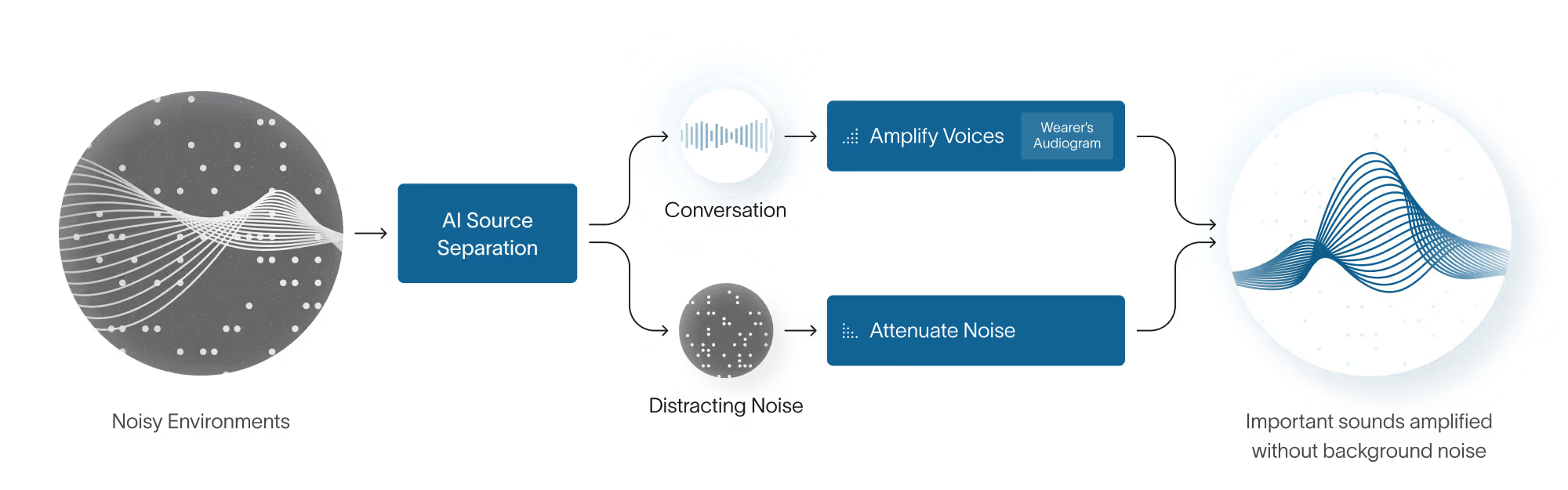
Using AI to process sound changes what is possible. Conventional sound processing relies on fixed rules to decide what to amplify, but Fortell’s AI can actually understand what to amplify based on what a sound is and where it’s coming from.
Fortell’s AI model, trained on millions of examples of speech and noise, recognizes the subtle patterns of human voices, allowing it to identify speech even in the most difficult environments. In a crowded room where multiple voices overlap, for example, Fortell’s AI can pick out a target voice and suppress the others.
By isolating speech and separating it from background noise first, Fortell’s AI can boost the specific sounds the listener is missing without amplifying distracting noise. This delivers a clear, high-contrast signal to the brain, allowing the wearer to follow a conversation with significantly less effort and mental strain.
Fortell put its AI hearing aids to the test in a double-blind, randomized controlled trial overseen by researchers at NYU Langone. The study focused on speech intelligibility, the ability to understand words clearly in loud environments. A target talker was positioned directly in front of the participant, while competing "distracting talkers" played from loudspeakers positioned behind them.
Researchers tested participants across three increasingly difficult signal-to-noise ratio (SNR) levels. SNR measures the level of a desired signal (often speech) against the level of background noise.
The results were significant, particularly in the most difficult environments where conventional hearing aids often fail:
Review the full body of peer-reviewed research behind these numbers, including study design and additional findings, on Fortell's clinical evidence page.
19x higher odds of understanding words correctly with Fortell vs. the leading AI hearing aid in the most challenging acoustic environments.
Before buying a hearing aid, ask a few general questions no matter which device you are considering:
If you want to determine which AI category a hearing aid falls into, ask these five targeted questions:
Ask if the device performs source separation. This is the ability to identify speech and noise as two distinct objects and treat them independently, allowing the system to turn down the noise path while cleanly amplifying the speech path.
A high-performance device should complete its calculations in milliseconds. If the AI only works on a "delay" or requires a smartphone to do the heavy lifting, it isn't true on-device source separation.
True real-time AI is power-hungry. In many conventional hearing aids, the high-level AI features drain the battery so quickly (often in 4–8 hours) that the hearing aid automatically turns the AI off to save power.
Many brands use internal "satisfaction surveys." These are not clinical evidence. Ask for a blinded randomized controlled trial. Specifically, look for data on "word recognition in noise." If they can't show you a study where the device was tested against its top competitors, the claim is likely marketing, not science.
Many demos are pre-recorded studio clips designed to sound perfect. Ask for a live demo in a truly noisy environment.
For decades, the standard response to hearing loss was simply to turn up the volume. But as millions of wearers have discovered, louder noise is not the same as clearer speech. The same microphone-processor-speaker mechanism that's defined hearing aids for decades is still there; what's changed is what happens inside the processor. By putting AI ahead of the traditional signal-processing chain, rather than relying on rule-based DSP alone, Fortell AI Hearing Aids solve the problem of understanding speech in noise, without changing what a hearing aid is or does.
If that's the hearing aid you've been picturing, one that finally understands the room instead of just amplifying it, the next step is simple. Book an appointment here with a Fortell audiologist, or find a clinic near you to start with a hearing evaluation.


Most people put their hearing aids in each morning, wear them throughout the day, and place them in their charging case at night. Depending on the device, day-to-day use might involve switching between listening modes for different environments, or adjusting volume, but the core routine is the same across styles.
People use hearing aids to make sound more accessible when they have hearing loss, most often loss caused by aging, noise exposure, or illness that damages the ear’s sensory hair cells. Hearing aids help wearers follow conversations, hear everyday sounds, and stay socially engaged without straining to hear.
The core benefit of a hearing aid is clearer, more accessible sound, which in practice means easier conversations and less listening effort. More advanced, AI-based hearing aids add a further benefit in specifically loud situations: the ability to separate a speaker's voice from background noise rather than simply amplifying everything together.
No. Hearing aids amplify and clarify sound for the hearing you have, hearing aids do not restore normal hearing and cannot prevent or improve hearing loss caused by natural processes such as aging or illness. Fortell's AI-native processing restores clarity to conversation, in environments where conventional hearing aids struggle most, not restore hearing itself. For more information on what to expect, see Fortell's full support FAQ.