

Clinical Research
/
December 2025
Clinical Trial Demonstrates Breakthrough Intelligibility Gains with Fortell

If you've ever said or heard someone say "I can hear you, I just can't understand you," you've put your finger on one of the most common and frustrating experiences of hearing loss.
Most people know hearing loss as a volume problem: sounds are too quiet, and a hearing aid turns them back up. But for many people with hearing loss, that's only part of the story. Even when speech is loud enough to be heard, changes in the way the ear and brain process sound can make speech—especially in noisy environments—much more difficult to understand.
Speech in noise testing was developed to measure exactly this kind of difficulty. This article explains what it is and why it matters for those struggling with hearing loss.
The conventional framework for understanding sensorineural hearing loss, the most common form of age-related hearing loss, identifies two distinct but overlapping problems¹.
The first is decreased audibility, a loss of sensitivity to quieter sounds. This is what a standard audiogram captures, and it's what conventional hearing aids are designed to address. Turn up the volume, restore the signal above threshold, and much of the problem is solved.
The second deficit is harder to solve: increased distortion. Even for sounds that are comfortably above the audible threshold, damage to the sensory structures of the inner ear degrades the brain's ability to process and comprehend speech. Unlike audibility, this type of loss doesn't show up cleanly on a pure-tone audiogram, and it doesn't respond well to amplification alone.
The clearest real-world signature of distortion is reduced speech comprehension in noisy environments. A person might understand speech perfectly well in a quiet room but struggle enormously in a restaurant, a car, or a crowded hallway.
To understand why background noise hits people with hearing loss so much harder, it helps to know a little about what the healthy hearing system actually does.
In healthy hearing, the ear and brain work via a sophisticated partnership. The ear captures sound waves as vibrations that flow through the middle and inner ear where they are converted into electrical signals by tiny specialized hair cells. These signals then travel to the brain where the brain decodes, organizes, and interprets the signals into meaningful sound.
With sensorineural hearing loss, the most common form of age-related hearing loss, the cells in the inner ear are damaged over time, causing fewer and weaker signals to reach the brain. This forces the brain to work harder to interpret sounds.
In healthy hearing, the ear and brain work via a sophisticated partnership…With sensorineural hearing loss, the cells in the inner ear are damaged over time, causing fewer and weaker signals to reach the brain.
In a noisy environment, all of that becomes much harder. For someone sensorineural hearing loss, several things² may be working against them at once:
Blurred frequency resolution. Normally, the inner ear acts like a very fine filter, separating sounds into precise frequency bands so the brain can make sense of them. With damage to the inner ear's hair cells, this precision degrades. Sounds that should be distinct start to blur together — like trying to read text that's slightly out of focus.
A squeezed comfort zone. Many people with hearing loss experience sounds going from inaudible to uncomfortably loud very quickly, with less comfortable listening range in between. When sounds get pushed toward the loud end of that range — as they often do in noisy environments — the brain actually extracts less useful information from them, not more.
Loss of the brain's "noise-canceling" ability. The healthy auditory system has a built-in mechanism for suppressing sounds in frequency ranges close to what you're listening to — a kind of biological noise cancellation that helps speech stand out. With hearing loss, this suppression weakens, making it harder to tune out competing sounds.
Difficulty tracking fast-changing sounds. Speech is full of rapid transitions. The "p" in "pat," the "s" in "stop," the subtle timing that distinguishes one word from another. The ability to track these rapid changes is often reduced with inner ear damage, blurring the edges of words.
Unwanted masking. Low-pitched sounds naturally tend to "mask," or drown out, higher-pitched sounds. In normal hearing, this stays relatively contained. With hearing loss, this masking spreads into higher frequency ranges, right where much of the clarity in speech lives, making consonants especially hard to hear.
The combination of these factors is different for every person. That's part of what makes sensorineural hearing loss so individual.
A standard hearing test, called an audiogram, measures how quiet a sound can get before you stop hearing it. It tells your audiologist a great deal about the audibility problem, but relatively little about the distortion problem.
This matters because the two don't always go hand in hand. Research has consistently shown that how well someone performs in noise doesn't track reliably with their audiogram results. Someone with mild hearing loss as measured by an audiogram may struggle enormously in noisy situations.
Even word recognition tests done in a quiet sound booth —another common part of a hearing evaluation — don't reliably predict how someone will perform in real-world noisy environments. The booth is quiet, the signal is clean, and the brain has all the contextual help it needs. Take away that quiet backdrop, add a restaurant full of noise, and the picture can look very different.
This is the gap that speech in noise testing was designed to fill.
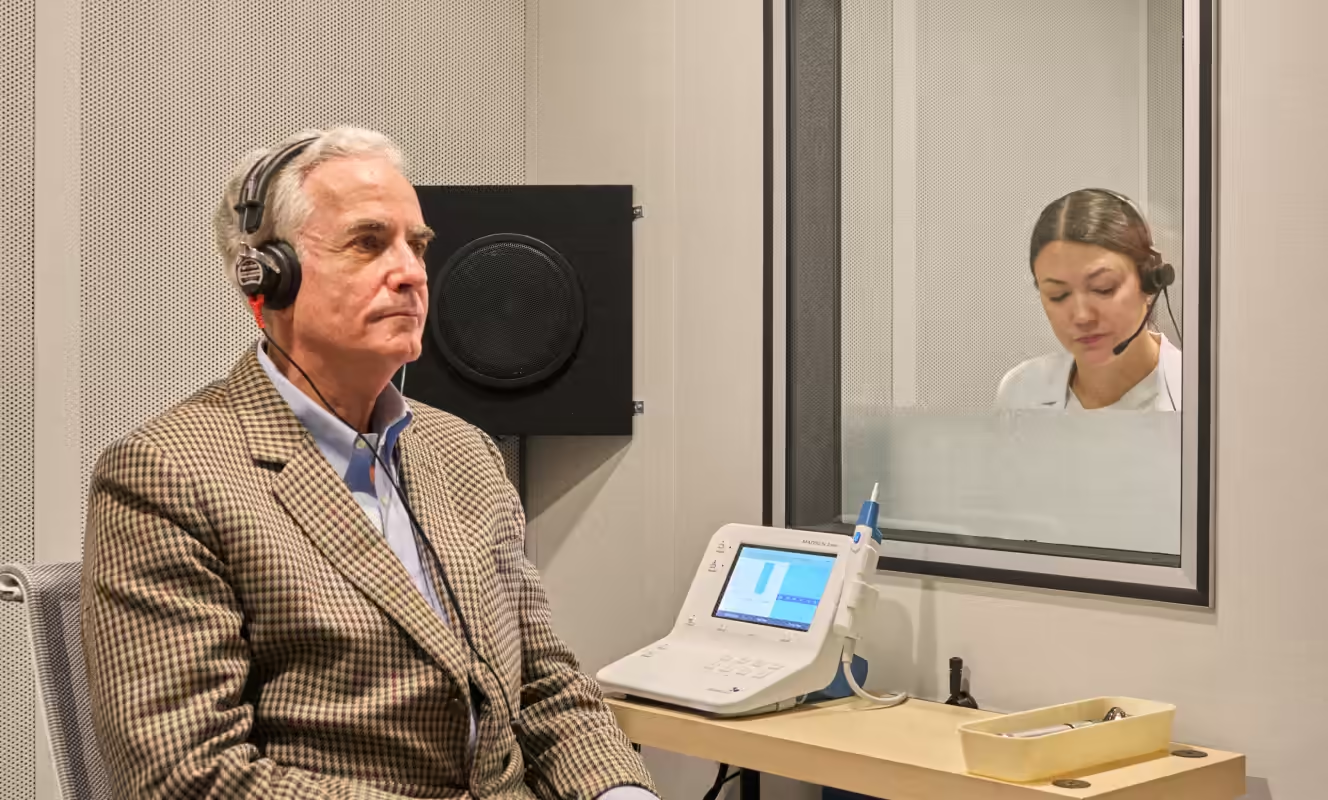
Speech in noise (SIN) testing presents words or sentences against a background of noise, and measures how well you can understand it. The key is that both the speech and the noise are carefully controlled, so the results can be compared and tracked over time.
There are several versions of these tests in clinical use, each with a slightly different design and purpose. The score on most of them is expressed as a signal-to-noise ratio, a measure of how much louder speech needs to be compared to the background noise for you to understand it half the time.
A lower number (or a negative number) means you can follow speech even when it's closer in volume to the noise around it. A higher number means you need speech to be significantly louder than the noise to follow a conversation.
Like the QuickSIN, the BKB-SIN³ uses a descending noise approach, starting with a lot of speech relative to noise and progressively making conditions harder.
It uses simple sentences with three key words each, scored against the level of noise at which you get half right.
An example sentence with keywords scored underlined: "The little girl is shouting.”
The BKB-SIN is particularly well-suited for people with more significant hearing loss, children, and cochlear implant users, as the simpler sentences reduce the chance that language difficulty itself affects the score.
The QuickSIN⁴ is designed to be fast, taking about a minute to complete. It presents six sentences, each containing five key words to listen for, while background babble from multiple talkers plays at the same time. The noise level increases with each sentence, making the task progressively harder.
An example sentence with scored keywords underlined: "It is a band of steel three inches wide."
The score — called SNR loss, or signal-to-noise ratio loss — reflects how much more signal a person needs compared to someone with normal hearing. A small SNR loss means the person functions close to normally in noise. A larger SNR loss means they need much more favorable listening conditions to keep up.
The Az Bio⁵ test evaluates your ability to understand full sentences while a 10-talker background babble plays at the same time. The sentences use natural conversations, but they purposely leave out helpful context clues so you can't just guess or "fill in" missing words.
Unlike tests that change difficulty as you go, the Az Bio keeps the background noise at one steady level for the whole test. Your audiologist can choose the level of background noise relative to the speech signal, or the signal-to-noise ratio.
Instead of just scoring a few keywords, every single word you get right counts toward your final percentage score.
If your biggest hearing complaint is about following conversations at dinner, keeping up in meetings, or hearing a friend in the car, a standard hearing test may not be giving your audiologist the full picture.
Speech in noise testing brings your real-world experience into the clinic. It gives your audiologist a concrete measure of how you're actually functioning. That information can change how your hearing loss is explained to you, how your hearing aids are programmed, and which hearing aids to pursue.
And perhaps most importantly, a speech in noise score can be validating. People with distortion-type hearing loss often feel that their difficulties aren't fully understood. They passed part of the hearing test, their hearing aids are turned up, but they're still struggling. A speech in noise score can put a number on an experience that's been hard to explain.
³ BKB-SIN™ Speech-in-Noise Test [compact disk]. Elk Grove Village (IL): Etymotic Research, Inc.; 2005.