

Product
/
August 2026
Fortell AI 2.0: The Data Behind our Biggest AI Update Yet
A note from Matt de Jonge, Fortell CEO and co-founder.
In August we released AI 2.0, the first major improvement to our award-winning Fortell AI Hearing Aids. That release improved both the naturalness of speech and the signal-to-noise ratio we deliver in the most challenging environments.1 Breaking with industry precedent, we made this material improvement available to all Fortell patients at zero-cost. <span class="rtb_aside">{Patients applauded.}</span>
A month later we submitted our hearing aids, running AI 2.0, for testing by HearAdvisor, the nation’s premier independent sound lab. We earned the highest scores they’ve ever awarded: 6.0 out of 5, literally breaking their scale. <span class="rtb_aside">{Angels sang.}</span>
Today we release AI 2.5, our most advanced AI ever. It measurably improves the quality of both speech and music, all while processing sound 15% faster than AI 2.0. Lower latency brings you closer to the way life used to sound before needing hearing aids. It’s a rising tide in every environment, but study after study has shown lower latencies are particularly beneficial to the naturalness of one's own voice.2 Benchmarking against the only other source-separating3 AI hearing aid, Fortell has 43% less latency, which means Fortell isn’t just the most effective source-separation hearing aid in the world–it’s the fastest by a wide margin with AI activated. <span class="rtb_aside">{Competitors weep.}</span>
AI 2.5 is bundled with another major improvement we call “Find My Hearing Aids,” which turns your iPhone into a hearing aid homing device. Misplaced hearing aids don’t stand a chance.
Better, faster, harder-to-lose Fortell hearing aids arrive today as another zero-cost, over-the-air update.4 To get started, make sure you have the latest version of the Fortell App from the iOS App Store. For more on the technology and science behind AI 2.5, read our white paper below.
When you trust Fortell with your hearing, you trust us to keep you on the bleeding edge. Today, the bleeding edge got faster. <span class="rtb_aside">{Crowd goes wild.}</span>
Thanks,
Matt de Jonge
CEO at Fortell
1. AI 2.0 also added support for Auracast, our most requested feature.
2. Groth & Søndergaard, 2004, Stone & Moore, 2005 Súsonnudóttir et al., 2026
3. AI powered source separation is the key concept that powers Fortell AI Hearing Aids. In essence, they separate incoming sounds into distinct tracks: important sounds, and unimportant sounds. The former can then be amplified while the latter is attenuated. More at: fortell.com/how-it-works
4. We considered calling this an “over-the-ear update” but we decided that was a bridge too far.

David Pattinson, Nathan Agmon, Israel Malkin, Mark Berry, Sam Russell, Ben Mazel, Abraham Neben, Ryan terMeulen, Igor Lovchinsky
November 2026
In independent testing and peer-reviewed clinical trials focused on listening performance and sound quality in background noise, Fortell AI Hearing Aids outperformed all others tested, including those claiming sophisticated on-board AI. Since their debut, they have also been the lowest-latency source-separation AI hearing aids on the market, but with AI 2.5, Fortell reduces processing latency a further 15% over AI 2.0, representing a meaningful improvement in a parameter known to be consistently influential to wearers’ perception of the naturalness of their own voice. With AI turned on, Fortell is now 43% faster than the leading source-separating competitor.
Fortell AI Hearing Aids run deep neural-network based processing on a custom, proprietary AI coprocessor designed in-house. The AI separates speech from interfering sound and re-renders the scene with the background noise attenuated. AI processing is available through two listening programs: “All Voices” which attenuates background noise while amplifying voices from all directions and “Front Voices” which goes further by suppressing talkers outside of a wearer’s gaze. Peer-reviewed clinical studies have shown that Fortell AI Hearing Aids improve both speech intelligibility and listener preference in multi-talker noise compared with other leading hearing aids (Morris et al., 2026a; 2026b).
The AI model is only one part of the signal path; sound picked up by the hearing aid’s microphones passes through a chain of digital signal processing (DSP) operations before it reaches the AI, and passes through further processing afterward. All sounds a wearer hears, whether speech, music, or their own-voice, pass through this whole chain, and its quality is affected by every step in the chain.
The previous release, AI 2.0, improved the core AI model by re-training on a large corpus of real-world recordings which substantially improved speech in noise performance (Pattinson et al., 2026). This AI 2.5 release improves the end-to-end signal processing chain. Two properties in particular benefit: 1) how quickly sound is processed (latency), and 2) how faithfully sound is reproduced (sound quality). This paper compares the latency and sound quality of AI 2.5 against the previous AI 2.0 release and benchmarks processing latency against the premier competitive device.
Why a shorter delay matters for the sound of your own voice
When we speak, we hear our own voice through vibrations conducted through bones in our head and through the air via our ear canal. A hearing aid adds an additional, slightly lagged, own-voice copy which can make own-voice sound unnatural. The longer the delay, the stronger this effect; own-voice studies consistently favor shorter delays (Groth & Søndergaard, 2004, Stone & Moore, 2005 Súsonnudóttir et al., 2026). A shorter processing delay is therefore positioned to make the wearer’s own voice sound more natural.
Speech and music were recorded with the AI 2.0 and AI 2.5 releases and objective measurements were computed. Latency through the hearing aids was measured as described below.
All recordings were made on a Knowles Electronics Manikin for Acoustic Research (KEMAR; GRAS Sound & Vibration, Denmark). Audio was played from a single speaker (Genelec 8010; Genelec, Finland) at ear height, 1 m from KEMAR. The same Fortell AI Hearing Aids were physically worn on KEMAR, running either AI 2.0 or AI 2.5. The hearing aids were fit using NAL-NL2 targets (Keidser et al., 2011) for an N3 audiogram (Bisgaard et al., 2010), a typical moderate sloping hearing loss. Power domes were used in order to limit the sound reaching the ear canal directly so that the recordings reflect the signal processing as closely as possible. Signals were captured by KEMAR’s ear-canal microphones at 44.1 kHz and high-pass filtered at 100 Hz to remove low-frequency background noise of the recording room. Every stimulus was also recorded with open (unaided) KEMAR ears to use as a reference.
Latency was measured by playing short sound pulses and recording both the original pulse and its amplified copy from the hearing aid.
The test material was 60 ten-second excerpts from the clean speech set of the Deep Noise Suppression (DNS) Challenge (Reddy et al., 2021), drawn from audiobooks read by 52 different talkers, with no background noise. None of these clips were used to train the AI models. The full set of clips was played three times, at 50, 65, and 80 dB SPL. The hearing aids were set to the All Voices program.
The music test material was 14 commercial recordings spanning solo piano, orchestral, string, vocal, and pop music, each up to 60 s long (14 minutes in total). The hearing aids were set to the Live Music program.
Speech quality was measured with the Hearing-Aid Speech Quality Index version 2 (HASQI v2; Kates & Arehart, 2014), and music quality with the Hearing-Aid Audio Quality Index (HAAQI; Kates & Arehart, 2016). Both metrics are built on a model of the impaired auditory periphery and were developed specifically to predict quality ratings by hearing aid users. Higher scores indicate better predicted sound quality. Both were configured for the N3 audiogram to match the fitting, and compare each aided recording against the unaided recording as the reference.
Each clip or track contributed its score averaged across the left and right ears (and, for the overall speech result, across the three levels). The two releases were compared with two-tailed paired t-tests across the 60 speech clips and 14 music tracks. Wilcoxon signed-rank tests were run as a distribution-free check and agreed with the t-tests on every comparison.
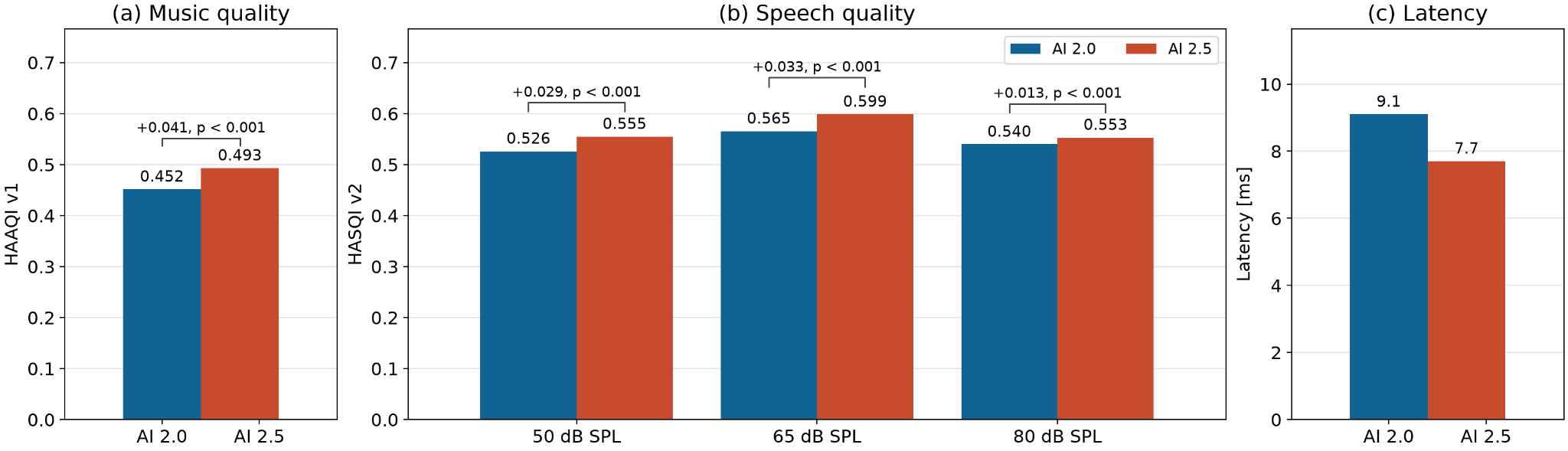
Music quality improved from 0.452 to 0.493 (Figure 1a), a mean improvement of 9.1% (p < 0.001). AI 2.5 scored higher than AI 2.0 on all 14 tracks.
Speech quality improved from 0.544 to 0.569, a mean improvement of 4.6% (p < 0.001). AI 2.5 scored higher on 54 of the 60 clips. Speech quality improved at every level (Figure 1b): by 0.029 at 50 dB SPL, by 0.033 at 65 dB SPL, and by 0.013 at 80 dB SPL (5.5%, 6.01% and 2.4% respectively, all p < 0.001). AI 2.5 scored higher on 58, 57, and 42 of the 60 clips at the three levels respectively.
AI 2.5 reduced the latency through the hearing aids from 9.1 ms to 7.7 ms, 1.4 ms (15%) shorter than AI 2.0 (Figure 1c).
Most major hearing aid manufacturers now claim AI in their marketing materials. The term can cover a range of functions in a hearing aid including scene classification, automatic adjustment of conventional processing, and noise reduction. By contrast, Fortell AI Hearing Aids perform true, real-time source separation to separate speech from noise using a deep neural network. To our knowledge, only one other manufacturer claims source separation. Using the method described above, we measured the latency of that device at 13.5 ms, with its AI turned on. AI 2.5 performs its real-time source separation nearly twice as fast, at 7.7 ms.
In independent academic research, listeners consistently prefer shorter delays, and rate their own voice as sounding more natural at lower latencies (Súsonnudóttir et al., 2026). While we have not measured the own-voice experience directly in this paper, the academic literature indicates AI 2.5’s reduced processing latency will improve wearers’ experience with their own voice relative to AI 2.0, and to an even greater extent, relative to the only other source-separation AI hearing aid on the market which processes sounds nearly two times slower.
The measured improvement in speech quality was largest for soft and conversational speech (50 and 65 dB SPL), and smaller for loud speech (80 dB SPL). Music quality improved on every track tested, across classical, vocal, and pop recordings.
These improvements in latency and sound quality are objective, manikin-based measurements, made with a single fitting. Fortell’s two latest AI releases are highly complementary: AI 2.0 made speech-in-noise clearer, improving the signal-to-noise ratio by 2.1 dB on average (Pattinson et al., 2026), while AI 2.5 accelerates all sound, including speech, music, and a wearer’s own voice, so that it reaches the ear faster and more faithfully. Both releases were measured on the same physical hearing aids, differing only in software. As with AI 2.0, AI 2.5 is available as a free over-the-air update to all existing Fortell patients.
Bisgaard N, Vlaming MSMG, Dahlquist M. (2010). Standard audiograms for the IEC 60118-15 measurement procedure. Trends Amplif. 2010;14(2):113–120. doi:10.1177/1084713810379609
Fortell. (2026). Fortell sets new hearing aid performance records in independent testing. Press release, September 16, 2026. https://www.fortell.com/blog/fortell-hearadvisor-press-release
Groth J, Søndergaard MB. (2004). Disturbance caused by varying propagation delay in non-occluding hearing aid fittings. Int. J. Audiol. 2004;43(10):594–599. doi:10.1080/14992020400050076
Kates JM, Arehart KH. (2014). The Hearing-Aid Speech Quality Index (HASQI) version 2. J. Audio Eng. Soc. 2014;62(3):99–117. doi:10.17743/jaes.2014.0006
Kates JM, Arehart KH. (2016). The Hearing-Aid Audio Quality Index (HAAQI). IEEE/ACM Trans. Audio Speech Lang. Process. 2016;24(2):354–365. doi:10.1109/TASLP.2015.2507858
Keidser G, Dillon H, Flax M, Ching T, Brewer S. (2011). The NAL-NL2 prescription procedure. Audiol. Res. 2011;1(1):e24. doi:10.4081/audiores.2011.e24
Morris C, Lovchinsky I, Callahan C, Wallace K, Berry M, Lyngaas K, Agmon N, Malkin I, Nagler B, Montano J, Weinstein B. (2026a). Spatial AI consistently preferred to state-of-the-art hearing aids in multitalker noise. Int. J. Audiol. 2026, 11:1-13. doi:10.1080/14992027.2026.2663345
Morris C, Lovchinsky I, Callahan C, Agmon N, Pattinson D, Lyngaas K, Malkin I, Shapiro W, Svirsky M. (2026b). Spatial AI improves speech intelligibility for hearing aid wearers in challenging multitalker noise. Int. J. Audiol. 2026, 8:1-13. doi:10.1080/14992027.2026.2741760
Pattinson D, Agmon N, Malkin I, Berry M, Russell S, Roumeliotis D, Lovchinsky I. (2026). The Fortell AI 2.0 update improves objective speech metrics across challenging noisy and multi-talker environments. Fortell Research white paper. https://www.fortell.com/blog/ai-update
Reddy CKA, Dubey H, Koishida K, Nair A, Gopal V, Cutler R, Braun S, Gamper H, Aichner R, Srinivasan S. (2021). INTERSPEECH 2021 Deep Noise Suppression Challenge. Proc. Interspeech 2021, 2796–2800. doi:10.21437/Interspeech.2021-1609
Stone MA, Moore BCJ. (2005). Tolerable hearing-aid delays: IV. Effects on subjective disturbance during speech production by hearing-impaired subjects. Ear Hear. 2005;26(2):225–235. doi:10.1097/00003446-200504000-00009
Súsonnudóttir B, Mosgaard LD, Stiefenhofer G, Souza PE, Neher T. (2026). Own-voice perception with different processing delays in open-fit hearing aids. Trends Hear. 2026;30:23312165261435260. doi:10.1177/23312165261435260