
Clinical Research
/
December 2025
About Hearing Loss

For decades, hearing aids have struggled with the same fundamental problem: in a noisy room, they can make sound louder, but they cannot make it clearer.
The result is that in situations where people need hearing aids the most — at a dinner table, in a busy restaurant, or at a family gathering — they are often unable to hear clearly and participate in conversations. This is the Cocktail Party Problem, and until now, no hearing aid had solved it.
Imagine standing in a crowded, dimly lit room. Dozens of people are talking at once, glasses are clinking, and music is playing in the background. Despite all the competing noise, a healthy hearing person is able to lean in and follow a conversation.
This seemingly effortless feat is what British scientist Colin Cherry coined the “Cocktail Party Problem.” Through a series of experiments, Cherry concluded that the brain acts like a filter, selectively tuning into voices the person wants to hear while ignoring distracting noises in the background.
The “problem” is that this sophisticated system is quite fragile. Even minor hearing loss can make this task more difficult.

Hearing begins when the outer ear captures sound waves and funnels them through the ear canal to the eardrum. These vibrations are then amplified by the ossicles—three tiny bones in the middle ear—which act as a mechanical bridge to the fluid-filled cochlea. Inside this spiral structure, thousands of microscopic hair cells act like a piano keyboard; specific frequencies trigger specific cells and convert into electrical impulses that the auditory nerve carries to the brain.
With sensorineural hearing loss, these hair cells are damaged or lost. This degrades the signal reaching the brain. Because the ear is sending incomplete data, the brain loses its ability to distinguish between subtle speech sounds (for example, the difference between "thin" and "sin"). It’s no longer just a volume problem — it’s a clarity problem.
This is why the Cocktail Party Problem is the ultimate challenge for those with hearing loss. In a noisy room, a healthy brain uses sharp data from both ears to zero in on one voice while ignoring background clatter. But when the incoming signal is impacted by damaged hair cells, the brain can’t find the edges of the speaker's voice to separate it from the noise.
In a noisy room, a healthy brain uses sharp data from both ears to zero in on one voice while ignoring background clatter.
The Cocktail Party Problem has gone unsolved for decades because engineers have been limited by conventional hearing aid technology, which relies on human-crafted rules and heuristics to process incoming sounds.
Conventional noise reduction algorithms, for example, assume that steady-state sounds like an AC hum are probably noise, while modulating sounds are probably speech. The system turns up the modulating sounds while attenuating the state-state sounds.
In a quiet room, where noise is primarily a steady background hum, this holds up. But in any lively social setting, background noise is not steady — it shifts, overlaps, and fluctuates in ways that appear similar to speech to a conventional noise reduction algorithm. In these scenarios, both speech and background noise are amplified, and the wearer is blasted with noise.
When Fortell's engineers first set out to solve the Cocktail Party Problem, the tools to do it didn't yet exist.
The deep learning models capable of enhancing speech at the speed and accuracy required for hearing aids were not available yet. The processing power needed to run them in a device small enough to sit behind an ear didn't exist. The training data — thousands of hours of real-world acoustic environments — hadn't been assembled.
Fortell engineers built all of it.
Fortell trained its AI model on thousands of hours of real speech across different voices, environments, and acoustic conditions until it could do what conventional hearing aids could never could: reliably separate speech from noise in any listening scenario.
The harder problem was packing that intelligence into a tiny chip that could fit inside a hearing aid. Fortell's team had spent their careers at the intersection of extreme compute and miniaturization, and they knew the only way to close that gap was to build a custom chip designed for the task.
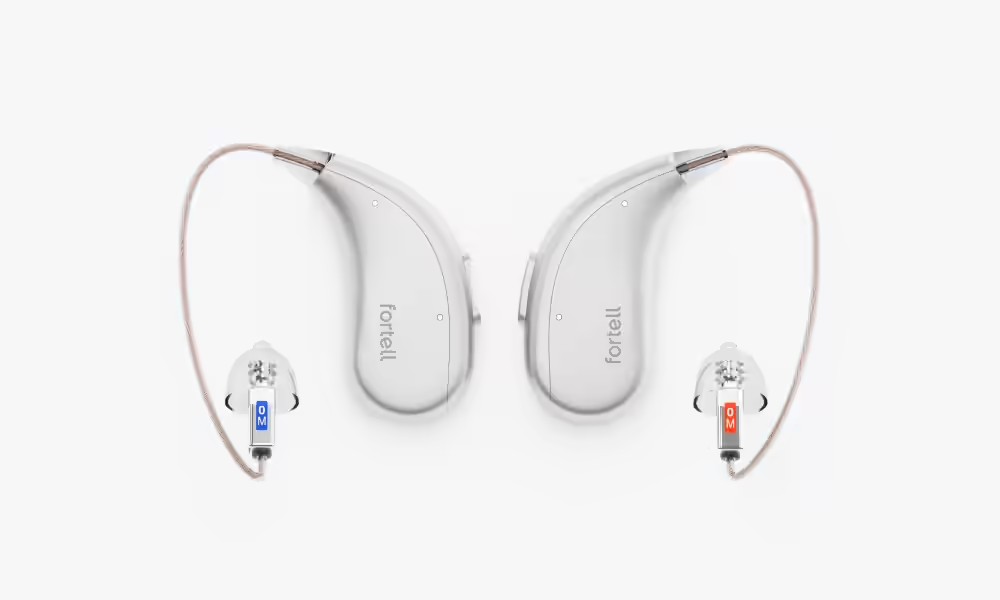
Working with TSMC (the world’s leading chip manufacturer), they did exactly that, building a proprietary AI chip powerful enough to run the models in real time, small enough to disappear behind a wearer’s ear and still maintain a 24+ hour battery life for all day wear.
Isolating speech, however, is only half the problem. In a noisy room there may be multiple voices — all of them recognizably speech. Separating the one that matters requires knowing where in space each sound is coming from and tracking those positions as the environment shifts.
This is where Fortell’s Spatial AI comes in. By processing the tiny timing and level differences between microphones, Fortell’s Spatial AI can locate where sounds are coming from.

For decades, the ability to hear a single voice in a crowded room was something only a healthy human brain could do. Fortell has built something that finally comes close: a hearing aid that thinks like a brain, running in real time, behind your ear.
For the millions of people who have quietly stopped going to the places they love because hearing there had become too hard, this changes everything.