
Product
/
November 2026
AI 2.5 Reduces Latency and Improves Sound Quality
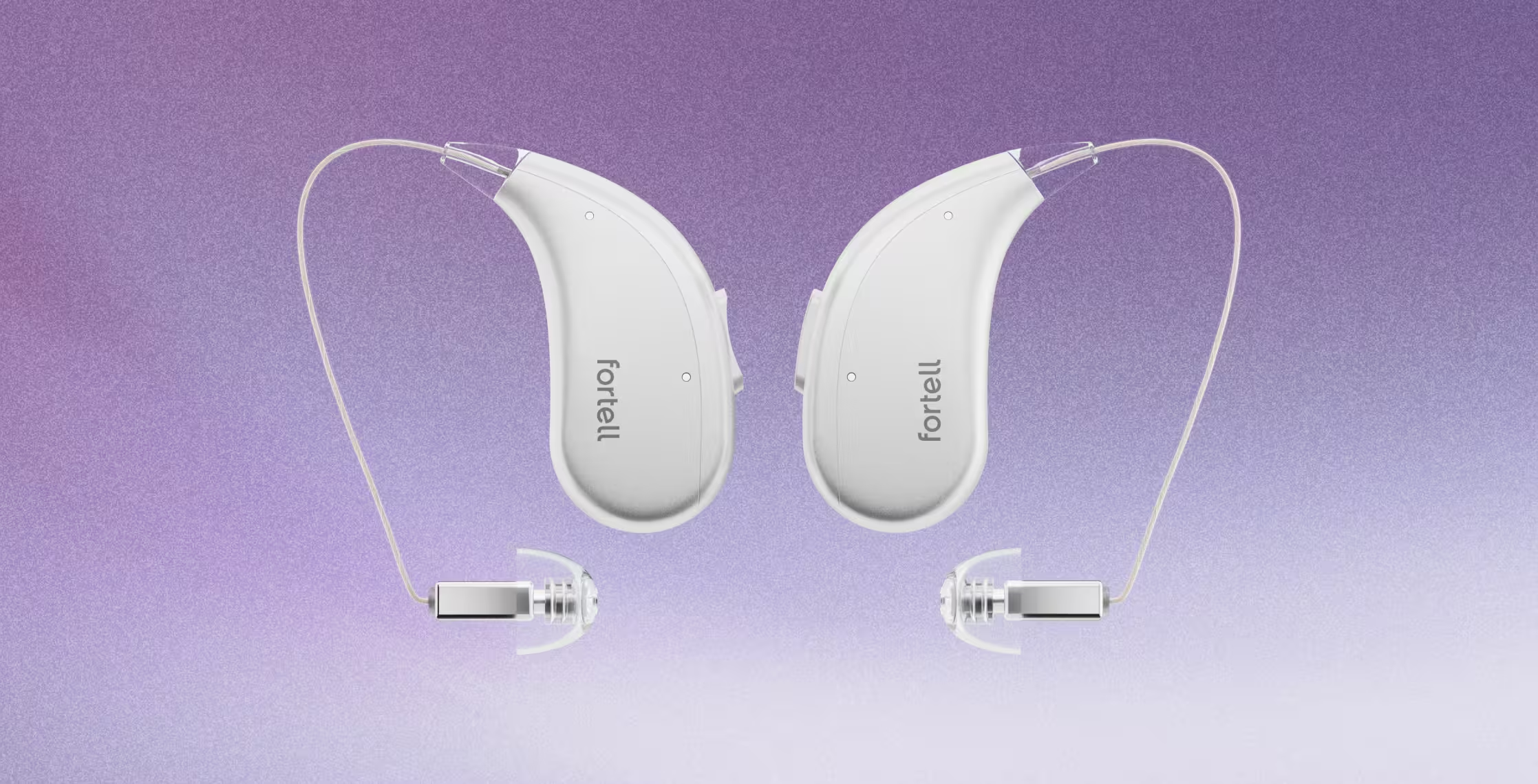
Fortell's AI is built to do something remarkably difficult: pick out the voice you want to hear from everything else happening around it. To do that, it needs to learn how to distinguish "important" sounds from "unimportant" ones across an almost infinite variety of listening environments.
That takes a lot of training data. One approach is to use synthetic recordings: take clean recordings of people talking, digitally layer background noise on top, and generate as many "noisy speech" tracks as you need. It's relatively fast, efficient, and easy to scale.
But we recognized early on that synthetic recordings could only take us so far. Real-world noise is unpredictable in nuanced ways that are difficult to fully recreate artificially. For example, the way someone talks over a crowded restaurant is different from the way they speak in a quiet room. If we want our AI to understand the complexity of everyday listening, it needs to learn from the real thing.
So we take a slower, scrappier approach. We send people out into the world with a backpack full of wires and microphones to capture sound as it actually happens, one environment at a time. The result is recordings from thousands of distinct environments, helping teach our AI to make sense of the sounds people encounter every day.
Here's a behind-the-scenes look at how we gather those recordings and put them to work making our hearing aids smarter.
Our recording work takes us to construction sites, subway stations, restaurants, bars and everywhere in between.
It's a full production. To capture sound from the listener's perspective, the recorder wears a large backpack with wires running out to a pair of headphones. Our earliest setup was decidedly DIY: a pair of headphones with microphones glued onto them.
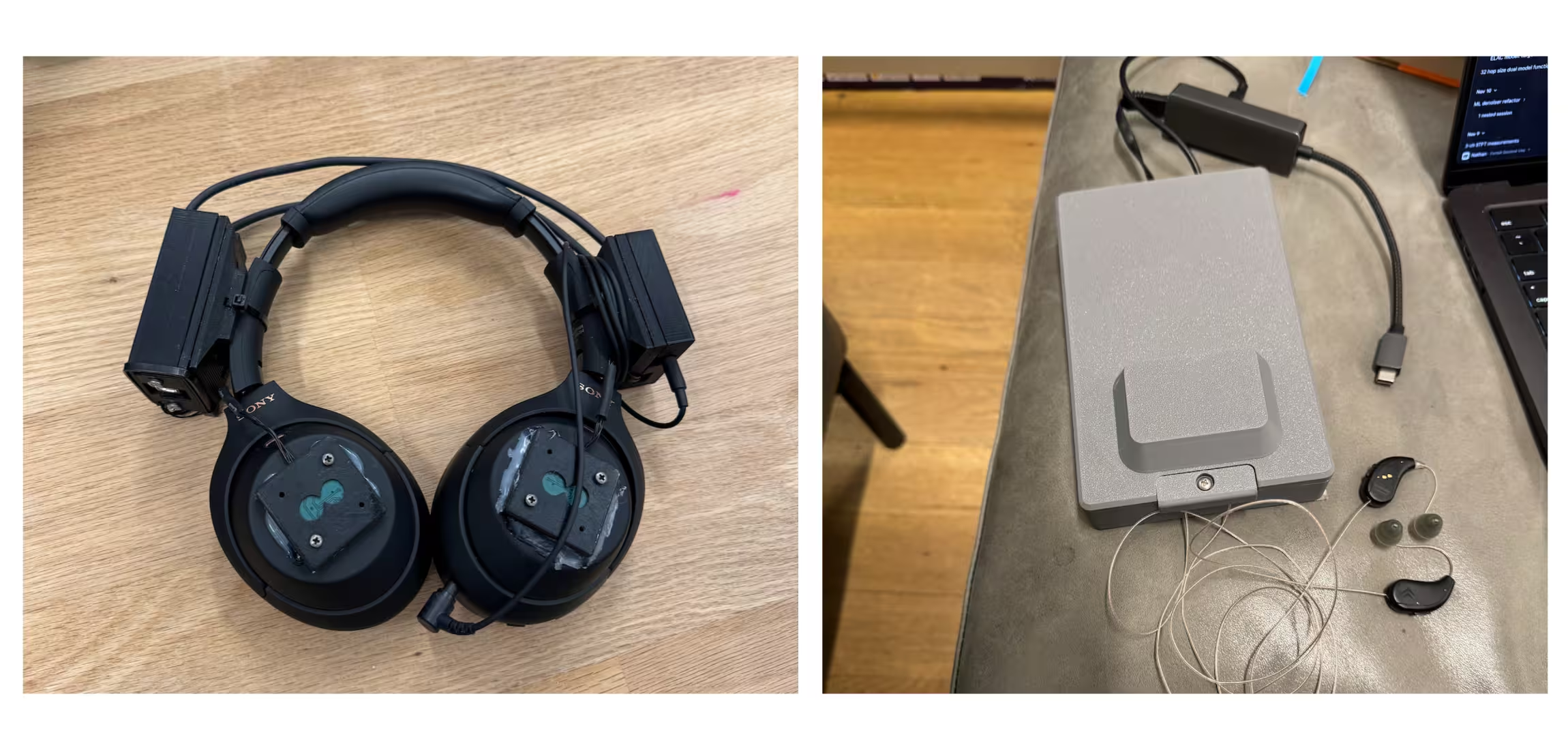
The equipment has come a long way since then. As our hearing aids have evolved, so has our recording setup. Today, we use actual Fortell AI Hearing Aids to capture audio through the built-in microphones. That means we're recording sound the same way our hearing aids receive it, giving us a much more accurate representation of the listening experience we're training our AI to handle.
Capturing background noise is only half the equation. We also need real people speaking within it, so the AI can learn to distinguish the voices someone wants to hear from everything happening around them.
To do this, we work with hundreds of participants representing a wide range of voices, accents, and languages. Our recording lead choreographs different scenarios: one person acting as the primary speaker while others carry on conversations nearby, or multiple people talking over one another in a busy restaurant.
The goal is to recreate the messy, unpredictable dynamics of real conversation, not just record people talking over noise.
Once collected, all that audio becomes training material for our AI. The goal is to expose the model to as many real-world listening scenarios as possible, so it learns to distinguish a voice someone wants to hear from the sounds competing for their attention.
The more real-world data we feed the model, the more it learns to handle the complexity of everyday listening. We're continually working to improve our model with an even richer set of diverse soundscapes.
While we're always researching, refining, and testing our AI models, we only release updated versions to wearers when we're confident it represents a meaningful step forward for patients. Every new version goes through rigorous research and testing before it ever reaches a patient's ears.
Gathering audio on foot with a backpack full of wires is not the most conventional way to build an AI model, especially for a small company. Collecting audio this way takes time, people, equipment, and a lot of effort. It's much easier to generate synthetic recordings and let the model learn from those.
But there's a difference between teaching AI what noise generally sounds like and teaching it to make sense of the unpredictable environments people actually live in. For a hearing aid, that distinction matters enormously.
Our goal isn't to build a model that performs well in a controlled, predictable setting. It's to build one that helps people follow conversations at a busy restaurant, keep up at a family gathering, or feel included in the everyday moments where hearing matters most.
That takes a deep understanding of the real world, and the willingness to go out and capture it.