
Product
/
June 2026
Inside the Booth: What Happens During a Hearing Test?
A "normal" audiogram doesn't always mean you can hear well in everyday life. Learn why this happens and what it means for understanding and treating your hearing loss.
Reviewed by Bess Nagler, Au.D.
.png)
You walk into your audiologist's office convinced something is wrong with your hearing. You can't follow conversations at the dinner table when more than two people are talking. Restaurants have become something to endure rather than enjoy. You expect the hearing test to explain what's happening.
Instead, the audiologist turns from the screen and delivers the verdict: your audiogram is "normal."
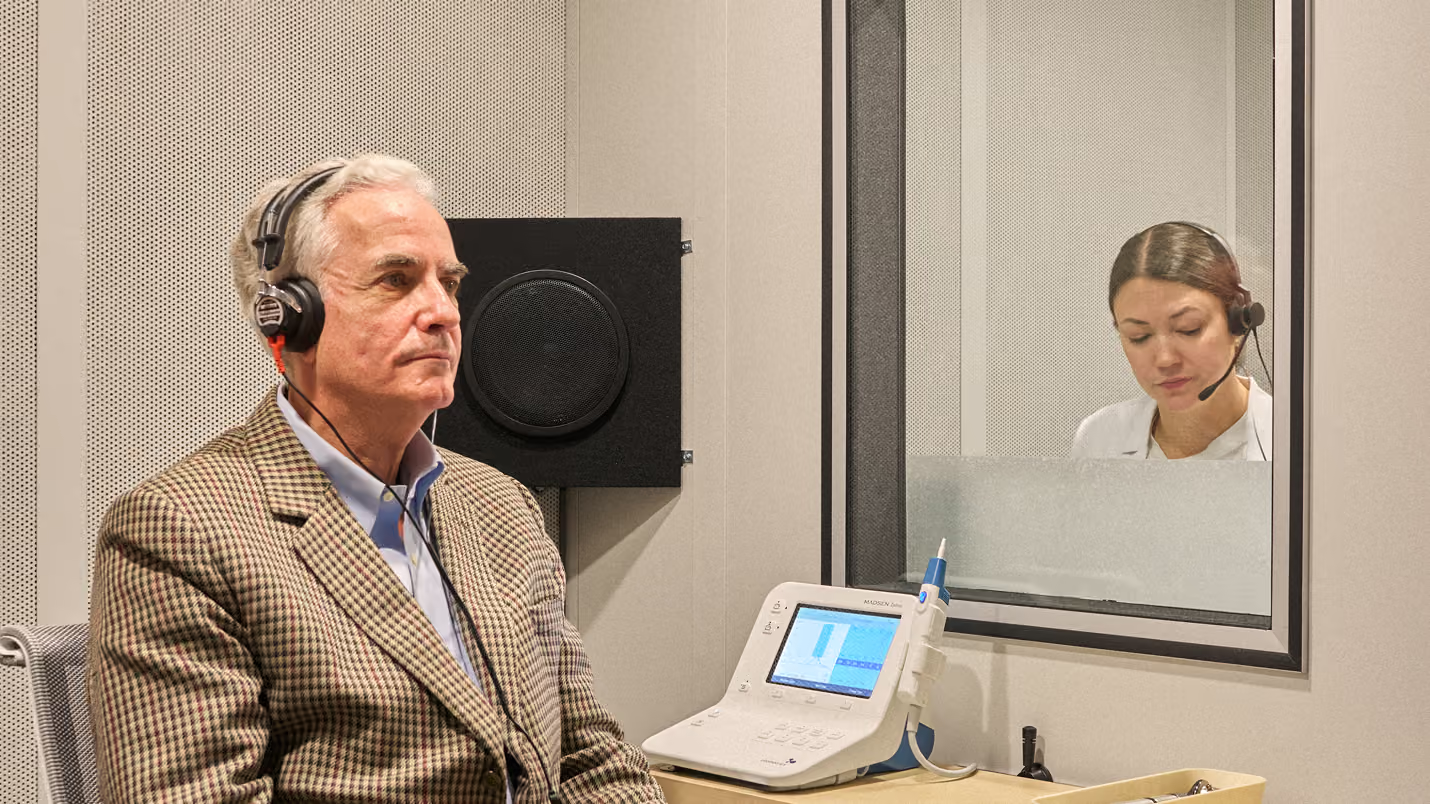
Some version of this scene plays out every day, and it highlights an important limitation of the standard hearing test. An audiogram answers one very specific question: Can you detect pure tones of different frequencies in a quiet room, one ear at a time? It's an essential clinical tool, but it bears little resemblance to the situations where people actually notice hearing problems: busy restaurants, family gatherings, crowded meetings, and other noisy environments.
A normal audiogram doesn't necessarily mean your hearing is functioning normally in everyday life. It simply means your ears can detect quiet sounds under ideal listening conditions.
Understanding speech in a noisy environment requires much more than simply hearing that sound exists. Your brain must rapidly separate one voice from competing conversations, clattering dishes, background music, and other distractions while filling in missing pieces of speech almost instantly.
Scientists sometimes describe this as an auditory "sorting" problem rather than simply a hearing problem. Detecting isolated tones in a soundproof booth is relatively simple. Following a fast-moving conversation in a crowded restaurant is far more demanding.
That's one reason someone can perform well on a traditional hearing test while still struggling in everyday listening situations.
Detecting isolated tones in a soundproof booth is relatively simple. Following a fast-moving conversation in a crowded restaurant is far more demanding.
One possible explanation comes from research led by Charles Liberman and colleagues at Harvard Medical School and Massachusetts Eye and Ear, who studied the effects of noise exposure in animal models.¹
Inside the cochlea, specialized hair cells convert sound into electrical signals. Those signals travel to the brain through tiny connections called synapses.
Liberman's laboratory found that moderate noise exposure could damage many of these synapses even when the hair cells themselves remained intact. In these cases, hearing thresholds eventually returned to normal, making the ear appear to have recovered. However, some of the underlying neural connections had been lost.
Researchers named this condition cochlear synaptopathy, often referred to as hidden hearing loss because the damage may not appear on a standard audiogram.
Scientists believe this type of damage may contribute to difficulty understanding speech in noisy environments. The affected synapses appear to help preserve the precise timing and sound cues the brain uses to distinguish one voice from another. When those cues become less reliable, separating speech from background noise can become much more difficult, even when hearing thresholds remain normal.
It’s important to note that while cochlear synaptopathy has been well documented in animal studies, researchers are still working to understand how often it contributes to hearing difficulties in humans.
{{inline-banner}}
Standard audiograms typically test only up to 8,000 Hz². Yet some of the earliest measurable effects of aging and noise exposure appear in the extended high frequencies above that range.
Those frequencies contain many of the acoustic cues that distinguish consonants like "s," "f," and "th." These subtle speech sounds help us tell words like fifty and sixty apart without relying entirely on context.
It's also worth noting that "normal" on an audiogram is a range, not a single value. Two people can both score inside that normal range, while one sits near its healthiest end and the other sits near its outer edge, with just enough softening in the higher tested frequencies. Both score "normal." Only one of them is likely to struggle following conversation in a crowded room.
If you've been told your hearing is normal but still struggle to understand conversations in noisy environments, it's worth asking your audiologist whether additional testing would provide a more complete picture.
A standard audiogram is excellent at measuring one thing: whether your ears can detect sound and understand speech in quiet. It was never designed to measure how well you can understand speech in a crowded restaurant or follow conversation at a lively family gathering.
That's why someone can honestly report significant hearing difficulties while also receiving a "normal" hearing test. The two findings are not necessarily contradictory.
If you've been told your hearing is normal but still struggle to understand conversations in noisy environments, it's worth asking your audiologist whether additional testing would provide a more complete picture. Speech-in-noise testing evaluates aspects of hearing that a standard audiogram simply wasn't designed to measure.
At Fortell, every patient receives a comprehensive audiological evaluation that includes audiometry, word-recognition testing, and speech-in-noise testing. Your audiologist will walk you through the results and what solutions exist to help you with your specific hearing challenges.


.avif)